When do Gemini Flash API prices go up, and by how much?
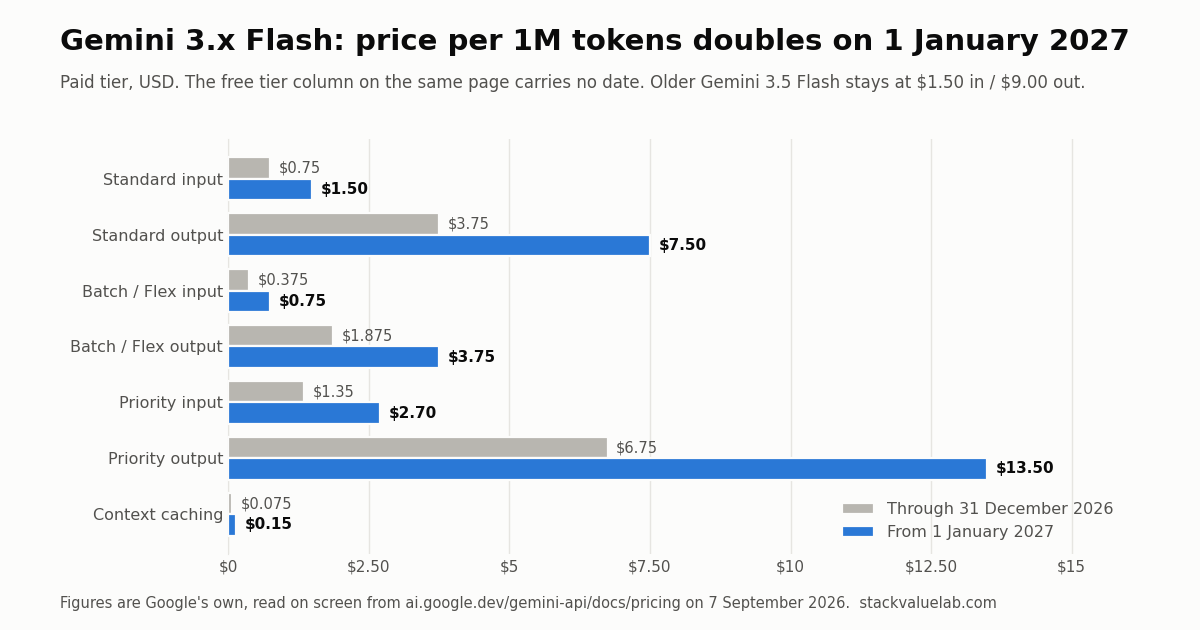
Google’s pricing page dates the Gemini 3.8, 3.7 and 3.6 Flash paid rates: $0.75 per million input tokens and $3.75 per million output tokens through 31 December 2026, then $1.50 and $7.50 from 1 January 2027. Batch, Flex, Priority and context caching double on the same date. The free tier column carries no date. Gemini 3.5 Flash ($1.50 / $9.00) and 3.5 Flash-Lite ($0.30 / $2.50) are unchanged.
Key finding A workflow making 1,000 calls a day at 2,000 tokens in and 500 out goes from $101 to $203 a month on 3.8 Flash Standard. Batch after 1 January costs what Standard costs today, so non-interactive work can absorb the whole increase by moving to Batch. OpenAI’s GPT-5.6 Sol promotional rate ($4 in, $20 out) is guaranteed only through 21 November 2026.
Prices verified 7 September 2026 against each vendor’s own pricing page, linked in full below.
Updated 11 September 2026. OpenAI has since announced a second API change for the same audience: whisper-1, gpt-4o-transcribe, gpt-4o-mini-transcribe and gpt-4o-transcribe-diarize leave the API on 26 February 2027, and the recommended replacement is 25% cheaper than whisper-1 but 50% dearer than the mini model. That has its own note. Nothing in this page changed.
KEY FINDING. Google’s own pricing page now carries an end date on the Gemini 3.x Flash rates: $0.75 per million input tokens and $3.75 per million output tokens “through December 31, 2026”, then $1.50 and $7.50 “starting January 1, 2027.” That is a doubling on Standard, Batch, Flex, Priority and context caching for Gemini 3.8, 3.7 and 3.6 Flash. For an automation that makes 1,000 calls a day at 2,000 tokens in and 500 out, the bill goes from $101 to $203 a month. The other date on the calendar is OpenAI’s: GPT-5.6 Sol’s $4 in / $20 out “promotional pricing is available at least through November 21, 2026.” Nothing on either page lets you lock the current rate.
This is a change note for people who pay for LLM calls from something they run themselves: an n8n workflow, a cron job, a bot on a VPS. Both pricing pages were read on screen on 7 September 2026 and are linked at the end. We have not benchmarked either model and this page does not say which is better. It says what the page says, when it changes, what that does to a monthly bill, and what the pricing page itself offers as a way around it.
Gemini 3.x Flash: the introductory rate ends on 31 December
Google does not announce this anywhere we could find; it is written into the price cells of the Gemini API pricing page for three models, Gemini 3.8 Flash, 3.7 Flash and 3.6 Flash, in the same words each time. Per million tokens, USD:
| Gemini 3.8 / 3.7 / 3.6 Flash, paid tier | Through 31 Dec 2026 | From 1 Jan 2027 | Change |
|---|---|---|---|
| Standard, input | $0.75 | $1.50 | x2 |
| Standard, output (including thinking tokens) | $3.75 | $7.50 | x2 |
| Batch and Flex, input | $0.375 | $0.75 | x2 |
| Batch and Flex, output | $1.875 | $3.75 | x2 |
| Priority, input / output | $1.35 / $6.75 | $2.70 / $13.50 | x2 |
| Context caching, per million cached tokens | $0.075 | $0.15 | x2 |
| Context caching storage, per million tokens per hour | $0.50 | $1.00 | x2 |
| Free tier (Standard) | Free of charge | Free of charge | no change stated |
Two things the table does not say on its own. First, the free tier column still reads “Free of charge” for all three models with no date attached, so a workflow that lives inside the free rate limits is not touched by this; we did not read the rate limits page and do not quote them here. Second, the doubled price is not a new high for Google’s Flash line. The older Gemini 3.5 Flash is $1.50 in and $9.00 out today, with no date on it. On 1 January, 3.8 Flash lands at the same input price and $1.50 less on output than the model it replaced. What ends is the introductory discount, not the price level of the family.
What it does to a monthly bill
One workflow, 30 days, every call 2,000 tokens in and 500 tokens out, Standard tier unless stated. Thinking tokens count as output on Gemini, so a model that thinks a lot will sit above these numbers. Figures are our arithmetic from the published rates.
| Calls a day | Tokens a month | 3.8 Flash now, $/mo | 3.8 Flash from 1 Jan, $/mo | Increase, $/mo | 3.8 Flash Batch from 1 Jan | 3.5 Flash-Lite (no change) | 3.5 Flash (no change) |
|---|---|---|---|---|---|---|---|
| 100 | 6M in, 1.5M out | 10.13 | 20.25 | 10.13 | 10.13 | 5.55 | 22.50 |
| 1,000 | 60M in, 15M out | 101.25 | 202.50 | 101.25 | 101.25 | 55.50 | 225.00 |
| 10,000 | 600M in, 150M out | 1,012.50 | 2,025.00 | 1,012.50 | 1,012.50 | 555.00 | 2,250.00 |
The Batch column is the interesting one. Batch also doubles, but because it starts at half the Standard rate, Batch after 1 January costs exactly what Standard costs today. A workflow that can wait for its answers (nightly summaries, classification runs, anything not user-facing) can absorb the whole increase by moving to Batch before the date. Gemini 3.5 Flash-Lite at $0.30 in and $2.50 out carries no date and is the cheapest thing on the page for simple steps: extraction, routing, yes-or-no decisions.
OpenAI: GPT-5.6 Sol’s promotional rate has a floor date, not an end date
OpenAI’s pricing page shows GPT-5.6 Sol at $4.00 input, $0.40 cached input, $5.00 cache writes and $20.00 output per million tokens on short context, and $8.00 / $0.80 / $10.00 / $30.00 on long context, with one sentence under the table: “GPT-5.6 Sol’s promotional pricing is available at least through November 21, 2026.” The page does not print the pre-promotional price. Press coverage from 23 August put it at $5.00 input and $30.00 output; we could not confirm that on an OpenAI page, so treat it as reported, not verified. “At least through” is also not a termination date: the rate can outlive 21 November, and OpenAI has not said what follows.
| OpenAI model, Standard, short context, per 1M tokens | Input | Cached input | Output | 1,000 calls a day, $/mo |
|---|---|---|---|---|
| gpt-6-astra | $10.00 | $1.00 | $50.00 | 1,350.00 |
| gpt-5.6-sol (promotional, at least to 21 Nov 2026) | $4.00 | $0.40 | $20.00 | 540.00 |
| gpt-5.6-sol at the press-reported pre-promo rate ($5 / $30), for scale only | $5.00 | $30.00 | 750.00 | |
| gpt-5.6-terra | $2.00 | $0.20 | $12.00 | 300.00 |
| gpt-5.6-luna | $0.20 | $0.02 | $1.20 | 30.00 |
For the same 1,000-call workflow, Sol at the promotional rate is $540 a month against $101 on Gemini 3.8 Flash today and $203 after 1 January. If the reported pre-promo rate returns, the Sol line becomes $750, a $210 step. Luna at $30 a month is OpenAI’s counterpart to Flash-Lite for the simple steps.
Who is affected
| Your situation | What the page says happens |
|---|---|
| Paid tier on Gemini 3.8, 3.7 or 3.6 Flash, any service tier | Every per-token line doubles on 1 January 2027; no lock-in offered |
| Free tier on those models | “Free of charge” with no date attached |
| Gemini 3.5 Flash and 3.5 Flash-Lite | No date on the page; prices as listed |
| GPT-5.6 Sol | Promotional rate guaranteed at least to 21 November 2026; what follows is unstated |
| Other OpenAI models | No promotional note on the page |
The cheapest way through it
Three moves, all of them things the pricing pages themselves put on the table. Move non-interactive Gemini work to Batch before 1 January; after the doubling, Batch is today’s Standard price. Route simple steps to Flash-Lite or Luna, which cost a fifth to a twentieth of the frontier Flash and Sol rates and carry no date. Cache what repeats: a long system prompt or a document that every call re-reads is billed at the cached rate, which is a tenth of the input rate on both vendors, though on Gemini the cached rate doubles too. What you cannot do is buy the current rate forward. Neither page offers a commitment, a reserved price or a grandfather clause.
Limits of this page
We read two pricing pages on 7 September 2026 and did nothing else: no API calls, no invoice, no rate-limit page. The monthly figures assume a fixed 2,000-in, 500-out call and ignore thinking tokens, grounding requests, image input and regional uplifts, any of which moves a real bill. The Gemini free-tier rate limits are not quoted here because we did not read that page. The OpenAI pre-promotional price is press-reported, not confirmed by OpenAI. If either vendor edits its page, the verified date at the top of this article is the date these figures were true.
Sources, read on screen 7 September 2026
- Gemini Developer API pricing (Gemini 3.8, 3.7, 3.6 Flash: “through December 31, 2026” and “starting January 1, 2027” cells; 3.5 Flash and 3.5 Flash-Lite rates)
- OpenAI API pricing (GPT-5.6 Sol, Terra, Luna, GPT-6 Astra rates; “promotional pricing is available at least through November 21, 2026”)
- Press report of the pre-promotional Sol rate, not verified against an OpenAI page: WinBuzzer, 23 August 2026
- Our running record of 2026 infrastructure price changes: the dated ledger, with the European cloud note and the Amazon SES note