When does OpenAI shut down whisper-1, and what does the replacement cost?
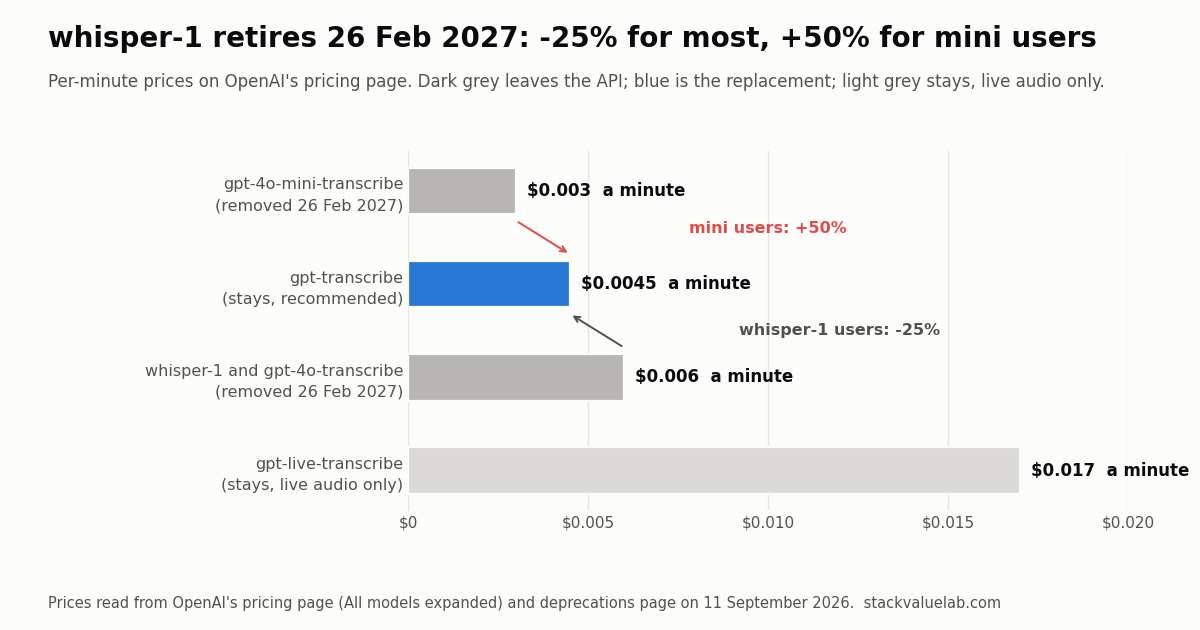
OpenAI removes whisper-1, gpt-4o-transcribe, gpt-4o-mini-transcribe and gpt-4o-transcribe-diarize from the API on 26 February 2027, announced 26 August 2026. The recommended replacement for recordings, gpt-transcribe, is $0.0045 a minute: 25% less than whisper-1 and gpt-4o-transcribe at $0.006, and 50% more than gpt-4o-mini-transcribe at $0.003. The other named replacement, gpt-live-transcribe, is $0.017 a minute and is for live audio. At 100 hours a month the move saves a whisper-1 user $9.00 and costs a mini user $9.00.
Key finding As of 11 September 2026 OpenAI’s file transcription guide still names whisper-1 as the only model for word timestamps and for translation into English, and gpt-4o-transcribe-diarize as the only one for speaker labels; all three are on the shutdown list and no successor is named yet. n8n’s OpenAI node uses whisper-1 by default for Transcribe a Recording. Per-minute figures for the gpt-4o models are OpenAI’s estimates beside token rates.
Prices verified 11 September 2026 against each vendor’s own pricing page, linked in full below.
KEY FINDING. OpenAI notified developers on 26 August 2026 that whisper-1, gpt-4o-transcribe, gpt-4o-mini-transcribe and gpt-4o-transcribe-diarize leave the API on 26 February 2027. The recommended replacement for recorded audio, gpt-transcribe, is priced at $0.0045 a minute. That is 25% less than whisper-1 and gpt-4o-transcribe at $0.006, and 50% more than gpt-4o-mini-transcribe at $0.003, so the same migration is a cut for most people and a rise for the people who had picked the cheapest model. Three jobs are harder than a model swap: as of 11 September 2026 OpenAI’s own guide still names whisper-1 as the only model for word timestamps and for translation into English, and gpt-4o-transcribe-diarize as the only one for speaker labels, and all three are on the shutdown list.
This is a change note for anyone who sends audio to OpenAI’s transcription endpoint, including through an automation tool that picked the model for you. Every figure below was read on screen on 11 September 2026 from OpenAI’s deprecations page, its pricing page and its file transcription guide, all linked at the end. We pay for the OpenAI API ourselves and have no affiliate relationship with OpenAI; there are no affiliate links on this page. The other API price change on our calendar, Gemini’s doubling on 1 January 2027, has its own note.
What changes, in OpenAI’s words
The deprecations page carries the notice under the heading “2026-08-26: Transcription models”: “On August 26, 2026, we notified developers using whisper-1, gpt-4o-transcribe, gpt-4o-mini-transcribe, and gpt-4o-transcribe-diarize of their deprecation and removal from the API on February 26, 2027.” The table beneath it gives the same shutdown date for all four and the same recommended replacement, “gpt-live-transcribe or gpt-transcribe”. That is six months of notice, and 168 days from the day this page was written.
| Model being removed | Shutdown date | OpenAI’s recommended replacement |
|---|---|---|
| whisper-1 | 26 February 2027 | gpt-live-transcribe or gpt-transcribe |
| gpt-4o-transcribe | 26 February 2027 | gpt-live-transcribe or gpt-transcribe |
| gpt-4o-mini-transcribe | 26 February 2027 | gpt-live-transcribe or gpt-transcribe |
| gpt-4o-transcribe-diarize | 26 February 2027 | gpt-live-transcribe or gpt-transcribe |
Two of the replacement names look alike and are not. gpt-transcribe is for a recording you already have: you upload a file and get a transcript back. gpt-live-transcribe is for audio still arriving from a microphone or a call. The guide is explicit that recorded speech should “start with gpt-transcribe”, and the price gap between the two is the largest number on this page.
What each model costs today, and what you move to
These are the per-minute figures on OpenAI’s pricing page on 11 September 2026. The four retiring models are still listed, under the page’s “All models” expander rather than in the default view, so a quick look at the page can miss them. The gpt-4o models are billed per token and the page gives a per-minute estimate beside the token rates; the others are quoted per minute only.
| Model | Price today | After 26 February 2027 | Move to gpt-transcribe at $0.0045 |
|---|---|---|---|
| whisper-1 (listed as “Whisper”) | $0.006 a minute | Removed | 25% less |
| gpt-4o-transcribe | $2.50 in, $10.00 out per 1M tokens; about $0.006 a minute | Removed | 25% less |
| gpt-4o-mini-transcribe | $1.25 in, $5.00 out per 1M tokens; about $0.003 a minute | Removed | 50% more |
| gpt-4o-transcribe-diarize | $2.50 in, $10.00 out per 1M tokens; about $0.006 a minute | Removed | 25% less, but gpt-transcribe does not label speakers |
| gpt-transcribe | $0.0045 a minute | Stays; the recommended model for recordings | |
| gpt-live-transcribe | $0.017 a minute | Stays; for live audio only | 3.8 times gpt-transcribe, 2.8 times whisper-1 |
| gpt-realtime-whisper | $0.017 a minute | Stays; live audio | Same as above |
The arithmetic is short. $0.0045 divided by $0.006 is 0.75, so whisper-1 and gpt-4o-transcribe users pay a quarter less after the move. $0.0045 divided by $0.003 is 1.5, so gpt-4o-mini-transcribe users pay half as much again, and there is no cheaper surviving model on the page to move to instead. Anyone who reads “gpt-live-transcribe or gpt-transcribe” and takes the first name pays $0.017, which is 3.8 times the second name and 2.8 times what whisper-1 costs now.
Three jobs the replacement does not do, according to the guide
OpenAI’s file transcription guide, read the same day, says to “start with gpt-transcribe” and to “use a specialized model only if you need speaker labels, word timestamps, subtitle formats, or translation into English.” It then names the specialized models, and every one of them is on the shutdown list.
| Job | What the guide says on 11 September 2026 | Status of that model |
|---|---|---|
| Word or segment timestamps, which is what caption and subtitle files are built from | “Use whisper-1 when you need word or segment timestamps.” “The timestamp_granularities[] parameter is only supported for whisper-1.” | Removed 26 February 2027; no successor named |
| Translation of a recording into English | “To translate a completed audio recording into English, use /v1/audio/translations with whisper-1.” | Removed 26 February 2027; no successor named |
| Speaker labels (who said what) | “Use gpt-4o-transcribe-diarize only when you need to identify who speaks during different parts of a recording.” | Removed 26 February 2027; no successor named |
| Plain transcript of a recording in its own language | “Start with gpt-transcribe.” | Stays, $0.0045 a minute |
We are describing the documentation as it stands, not predicting what OpenAI will ship. A successor for these three jobs may well appear before February; the deprecation notice points to the guide “for information about the recommended replacements”, and the guide does not yet have one for them. What that means today is that a caption pipeline, a translation step or a meeting-notes tool built on those models cannot be migrated blind. Swapping the model name to gpt-transcribe turns the timestamps, the English output or the speaker labels off.
What a real workload pays
Per-minute rates multiplied out. Sixty minutes is one hour of audio; 6,000 minutes is a hundred hours, roughly a podcast archive or a month of call recordings for a small team. All figures are the list prices above times the minutes, with no volume discount assumed because the page does not publish one for these models.
| Minutes a month | whisper-1 or gpt-4o-transcribe today, $0.006 | gpt-4o-mini-transcribe today, $0.003 | gpt-transcribe, $0.0045 | gpt-live-transcribe by mistake, $0.017 |
|---|---|---|---|---|
| 1,000 (about 17 hours) | $6.00 | $3.00 | $4.50 | $17.00 |
| 6,000 (100 hours) | $36.00 | $18.00 | $27.00 | $102.00 |
| 30,000 (500 hours) | $180.00 | $90.00 | $135.00 | $510.00 |
At a hundred hours a month the move saves a whisper-1 user $9.00 and costs a mini user $9.00. Both are small next to the $75.00 gap between choosing gpt-transcribe and choosing gpt-live-transcribe for the same recordings. The model name, not the deprecation, is where the money is.
The cheapest way through it
If you send recordings and only need the text, change the model name to gpt-transcribe now rather than in February. It is the cheaper of the two survivors, it is the one the guide recommends for recordings, and there is nothing to gain by waiting. If you are on gpt-4o-mini-transcribe, the same move is a 50% rise and OpenAI has no cheaper model left for the job; the choice is to budget the increase or to price the job elsewhere before February, which we have not done here. If you depend on timestamps, translation or speaker labels, do not migrate yet: keep the current model until either the guide names a successor or your own test of gpt-transcribe shows you can live without the feature, and note that both whisper-1 and gpt-4o-transcribe-diarize still work until 26 February 2027. In every case, check that the model you end up calling is gpt-transcribe and not gpt-live-transcribe; the second one is for streams and costs 3.8 times as much.
Who is affected
| Your situation | What happens |
|---|---|
| Your code sends model: whisper-1 to /v1/audio/transcriptions | It stops working on 26 February 2027. For plain transcripts, gpt-transcribe is the drop-in and costs 25% less |
| You use an automation tool’s OpenAI node to transcribe audio | Check which model it sends. n8n’s documentation for its OpenAI node states that for “Transcribe a Recording”, “OpenAI will use the whisper-1 model by default”, and its “Translate a Recording” operation uses the translation endpoint the guide ties to whisper-1 |
| You chose gpt-4o-mini-transcribe for the price | The cheapest surviving model is gpt-transcribe at $0.0045, a 50% rise |
| You build subtitles or captions from word timestamps | The guide names only whisper-1 for timestamp_granularities. No successor is named yet |
| You translate recordings into English through the API | The guide names only whisper-1 for /v1/audio/translations. No successor is named yet |
| You need speaker labels | gpt-4o-transcribe-diarize is the only named model and is on the shutdown list |
| You already use gpt-transcribe or gpt-live-transcribe | Nothing changes for you in this notice |
| You use the Realtime or audio chat models | A separate notice from 20 July 2026 retires the legacy gpt-realtime and gpt-audio families on 20 January 2027; that is not covered here beyond this row |
Limits of this page
We read three OpenAI pages and one n8n page and did arithmetic on them. The per-minute figures for the gpt-4o models are OpenAI’s own estimates printed beside token rates; actual token counts vary with the audio, so a real bill can differ from the estimate in either direction. We did not benchmark transcription quality, latency or language coverage between whisper-1 and gpt-transcribe, so nothing here says the cheaper model is better or worse at the job. We did not price competing transcription APIs. The statement that no successor is named for timestamps, translation and diarization describes the guide on 11 September 2026 and will be out of date the day OpenAI updates it. If any figure here stops matching OpenAI’s page, the verified date at the top of this article is the date it was true.
Sources, read on screen 11 September 2026
- OpenAI: Deprecations (“2026-08-26: Transcription models”, the four models, “February 26, 2027”, “gpt-live-transcribe or gpt-transcribe”; also “2026-07-20: Legacy audio, realtime, and transcription models”, 20 January 2027)
- OpenAI: Pricing, Transcription models table with “All models” expanded (Whisper $0.006, gpt-4o-transcribe $2.50 / $10.00 and about $0.006, gpt-4o-mini-transcribe $1.25 / $5.00 and about $0.003, gpt-4o-transcribe-diarize about $0.006, gpt-transcribe $0.0045, gpt-live-transcribe and gpt-realtime-whisper $0.017, all per minute)
- OpenAI: File transcription guide (“Start with gpt-transcribe”, “only supported for whisper-1”, “/v1/audio/translations with whisper-1”, “Use gpt-4o-transcribe-diarize only when”, files up to 25 MB)
- OpenAI, 2023, updated 24 April 2024: Introducing ChatGPT and Whisper APIs (“priced at $0.006 / minute”, the same figure the pricing page shows today)
- n8n: OpenAI node, audio operations (“OpenAI will use the whisper-1 model by default”)
- Our running record of dated price changes: the infrastructure price change ledger. The other API rate change on the calendar: Gemini’s doubling on 1 January 2027