What does Amazon SES cost for a new account in 2026?
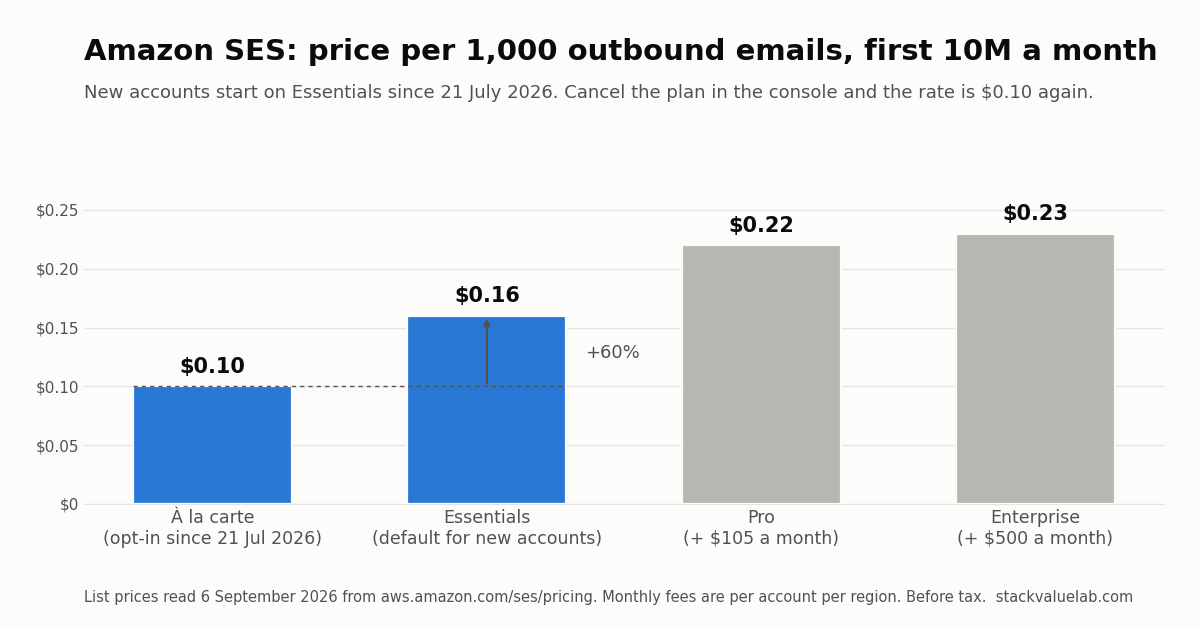
A new SES account created since 21 July 2026 starts on the Essentials plan at $0.16 per 1,000 outbound emails. The $0.10 per 1,000 à la carte rate still exists: open the Pricing plan page in the SES console and choose Cancel plan, which takes effect immediately for accounts that were defaulted onto the plan. The SES-specific free tier of 3,000 messages a month for 12 months is no longer offered to new customers.
Key finding The difference is 60% up to 10 million emails a month: $1.44 a year at 2,000 emails a month, $72 at 100,000, $720 at one million. Pro ($0.22 plus $105 a month) and Enterprise ($0.23 plus $500 a month) never beat à la carte on the per-email price alone.
Prices verified 6 September 2026 against each vendor’s own pricing page, linked in full below.
Updated 8 September 2026. Corrected an over-generalisation: the 60% gap holds up to 10 million emails a month, not at every volume. Amazon prices Essentials in three marginal bands and the gap narrows above the first one, so the band structure and two worked examples are now on the page.
KEY FINDING. Since 21 July 2026, a new Amazon SES account is placed on the Essentials plan at $0.16 per 1,000 outbound emails. The $0.10 per 1,000 à la carte rate that every older guide quotes still exists, but a new account has to cancel the default plan to get it. That is a 60% difference on every email up to 10 million a month: $1.44 a year at 2,000 emails a month, $72 a year at 100,000, $720 a year at one million. Above 10 million the Essentials rate steps down and the gap narrows, worked through below. The SES-specific free tier of 3,000 messages a month is no longer offered to new customers. The fix is one page in the console and takes effect immediately.
This is a change note, not a review. Every figure below was read on 6 September 2026 from AWS’s own pricing page, developer guide and announcement post, all linked at the end. We have not benchmarked deliverability and this page does not say which relay is best. It says what the price is now, who it applies to, and what to click.
What changed, in AWS’s words
On 21 July 2026 AWS introduced three SES pricing plans, Essentials, Pro and Enterprise, alongside the existing à la carte pricing. Two sentences in the announcement carry the whole change. First: “Starting July 21, 2026, all new SES accounts begin on the Essentials plan.” Second: “the SES-specific free tier (3,000 email message charges per month for your first 12 months after first SES use) is no longer available for new customers.”
The pricing page adds the part that matters for cost: “You can upgrade or switch to à-la-carte pricing at any time.” So the cheaper rate was not withdrawn. It was made opt-in for anyone who arrives after 21 July.
The four prices
| Pricing option | Per 1,000 emails, first 10M a month | 10M to 100M | Over 100M | Monthly fee |
|---|---|---|---|---|
| À la carte | $0.10 | $0.10 | $0.10 | none |
| Essentials (default for new accounts) | $0.16 | $0.14 | $0.11 | none |
| Pro | $0.22 | $0.17 | $0.12 | $105 per account per region |
| Enterprise | $0.23 | $0.18 | $0.13 | $500 per account per region |
Outbound email only, before tax. Attachment data is billed separately at $0.12 per GB. The plans bundle features that à la carte charges for individually; AWS says the bundle is “up to 22% less than purchasing them individually.” We have not priced those features here, so this page only answers one question: if you send plain transactional mail and use none of the bundled features, what does the default cost you?
Who is on which price
| Your situation | Where you start | Source wording |
|---|---|---|
| New SES account created on or after 21 July 2026 | Essentials, $0.16 | “all new SES accounts begin on the Essentials plan” |
| Existing account with no metered SES activity since 1 June 2025 | Essentials, $0.16 | “Returning customers who have not sent or processed email through SES since June 1, 2025 also begin on the Essentials plan” |
| Existing account that sent or processed email on or after 1 June 2025 | À la carte, $0.10, unchanged | “remain on à-la-carte pricing and can switch to a plan anytime” |
| Already inside the old 12-month free tier | Free tier continues | “your benefits continue for the remainder of your 12-month period” |
The second row is the one people will miss. An old AWS account that set up SES years ago, went quiet, and comes back to wire up a new WordPress site is treated as new. The pricing page says the default applies per “account x region” combination, so an account that is active in one region and opens SES in a second region starts that region on Essentials too.
What the default costs, by volume
Twelve months of sending at a steady monthly volume, first-band prices, no attachments, no bundled features used. The Pro column includes its $105 monthly fee for one region.
The band matters once you are large. Essentials is priced in three bands and Amazon applies them marginally, so each rate covers only the emails inside it: $0.16 per 1,000 up to 10 million a month, $0.14 from 10 to 100 million, $0.11 above 100 million. The a la carte rate is a flat $0.10 at any volume, so the penalty for leaving the default plan in place shrinks as you grow. At 20 million a month Essentials is $3,000 against $2,000 a la carte, a 50% difference; at 200 million it is $25,200 against $20,000, or 26% [CALCULATED]. Every row in the table below sits inside the first band, where the gap is the full 60%.
| Emails a month | À la carte, $/yr | Essentials, $/yr | Default costs you, $/yr | Pro, $/yr |
|---|---|---|---|---|
| 2,000 | 2.40 | 3.84 | 1.44 | 1,265.28 |
| 10,000 | 12.00 | 19.20 | 7.20 | 1,286.40 |
| 50,000 | 60.00 | 96.00 | 36.00 | 1,392.00 |
| 100,000 | 120.00 | 192.00 | 72.00 | 1,524.00 |
| 1,000,000 | 1,200.00 | 1,920.00 | 720.00 | 3,900.00 |
Two things fall out of that table. At WordPress volumes the dollar difference is small: a site sending 2,000 messages a month loses $1.44 a year by staying on the default. At anything that looks like an application, the 60% is real money, and it is money that shows up on the bill of the person who did not read the pricing page. And Pro never wins on the per-email price alone; its $1,260 a year of fees only pays back if you were going to buy the bundled features anyway.
The free tier that went away is worth $3.60
The retired SES free tier was 3,000 message charges a month for the first 12 months. That is 36,000 messages, which at the à la carte rate is $3.60 and at the Essentials rate is $5.76. It was never the “62,000 free emails a month from EC2” allowance that older tutorials still describe; that one left the page before this change. If a guide tells you SES is free, it is describing a pricing page that no longer exists.
What a brand-new AWS account gets instead is the general AWS Free Tier: “up to $200 in credits during your first six months that you can apply toward Amazon SES pricing plans.” At 2,000 emails a month, Essentials costs $0.32 a month, so the credits cover it many times over until they expire. The default only starts costing a small sender anything in month seven. The announcement ties the credits to the plans; we did not find a sentence saying they apply to à la carte charges, so we are not claiming that they do.
How to get the $0.10 rate on a new account
From the SES developer guide, which is the only place we found the mechanics written down: open the Pricing plan page in the Amazon SES console and “Choose Cancel plan to return to à la carte pricing.” Timing matters and the guide is specific about it: “If you did not explicitly choose a plan and were defaulted to the Essentials plan, your first downgrade or cancellation to à la carte pricing also takes effect immediately.” Any other downgrade or cancellation waits for the start of the next billing cycle.
So the order of operations for a new WordPress site is: create the SES identity, verify the domain, request production access as before, then before sending the first message, open Pricing plan and cancel. The cancellation is immediate, the rate becomes $0.10, and nothing else about the account changes. If you instead want one of the bundled features, price the bundle against the à la carte feature charges first; the plans were built for that comparison, not for plain sending.
Where this sits in a WordPress bill
Our running-costs article prices one site’s transactional email at $2.40 a year on SES à la carte, 2,000 messages a month. That figure stands, with the condition this page adds: a new account has to cancel the default plan to get it. Left on Essentials the line is $3.84. For a site under 1,000 messages a month, SMTP2GO’s free tier (1,000 a month, capped at 200 a day) and Postmark’s (100 a month) take the line to zero with no console work, at the price of a lower ceiling. Those two figures were read on 6 September 2026 as well.
Other 2026 price changes we have verified against the vendor’s own page
This note is one entry in our running ledger of 2026 infrastructure price changes, each checked against the vendor’s own announcement on a stated date. Entries so far, all read on 6 September 2026:
- Hetzner Cloud, effective 15 June 2026: server prices raised “for new orders and cloud instance rescales”; running servers keep their price until changed. Our line-by-line table.
- Backblaze B2, effective 1 May 2026: pay-as-you-go storage “from $6/TB to $6.95/TB”, and standard API calls made free for all customers. Committed contracts keep their price until renewal.
- netcup: new orders from 19 March 2026 “will increase by 24.33%”; existing hosting contracts “will increase by 18.51%” from the first billing period after 1 May 2026; Storage Space and Local Block Storage add-ons up 21.52% on 1 May.
- .com domains, effective 1 November 2026: Verisign raises the wholesale fee “from $10.26 to $10.97”. Porkbun has already posted its pass-through: “approximately $11.81” from 04:00 UTC that day.
- OVHcloud, effective 1 October 2026: local disk and public IPv4 become separate lines on B3, C3 and R3 instances, the same configuration costing 1.4% to 21.9% more. Our per-instance table and the 2026 European ledger.
- Amazon SES, effective 21 July 2026: this page.
Limits of this page
We did not send a message through SES to produce this note; the prices are published list prices and the console path is quoted from the developer guide, not from a screenshot of our own account. We did not price the features the plans bundle (dedicated IPs, deliverability tooling, mail management), so “Pro never wins on price” means on the per-email price alone. Volume bands above 10 million a month are shown for completeness and were not checked against an invoice. If AWS changes any of this, the verified date at the top of this page is the date our figures were true.
Sources, read 6 September 2026
- AWS announcement, 21 July 2026: Introducing Amazon SES pricing plans
- Amazon SES pricing (plan prices, à la carte rate, default-plan rule)
- SES Developer Guide: Pricing plans (Cancel plan, immediate effect for defaulted accounts)
- SMTP2GO pricing, Postmark pricing
- Ledger entries: Hetzner price adjustment, Backblaze pricing and product updates, netcup price adjustment, Verisign Q1 2026 results, Porkbun on .com prices